


The Top Manway Fermentation Tank is a specialized fermentation vessel engineered with a pressure manway positioned at the tank’s top, a design that optimizes functionality for controlled fermentation environments. Unlike traditional fermentation tanks with side-mounted access points, this tank prioritizes ease of use, hygiene, and operational safety—key factors for industries where consistent fermentation results and product quality are critical.
Crafted primarily from high-grade stainless steel, the tank ensures exceptional durability, resistance to corrosion, and compliance with food and beverage hygiene standards. Its structure is tailored to minimize contamination risks, maintain airtight conditions, and simplify routine upkeep, making it a reliable choice for small-scale craft producers and large-scale industrial facilities alike. Whether used for yeast-driven fermentation in beer brewing or microbial processes in kombucha production, the tank’s top manway design addresses core pain points of traditional vessels, such as difficult access and leak vulnerabilities.
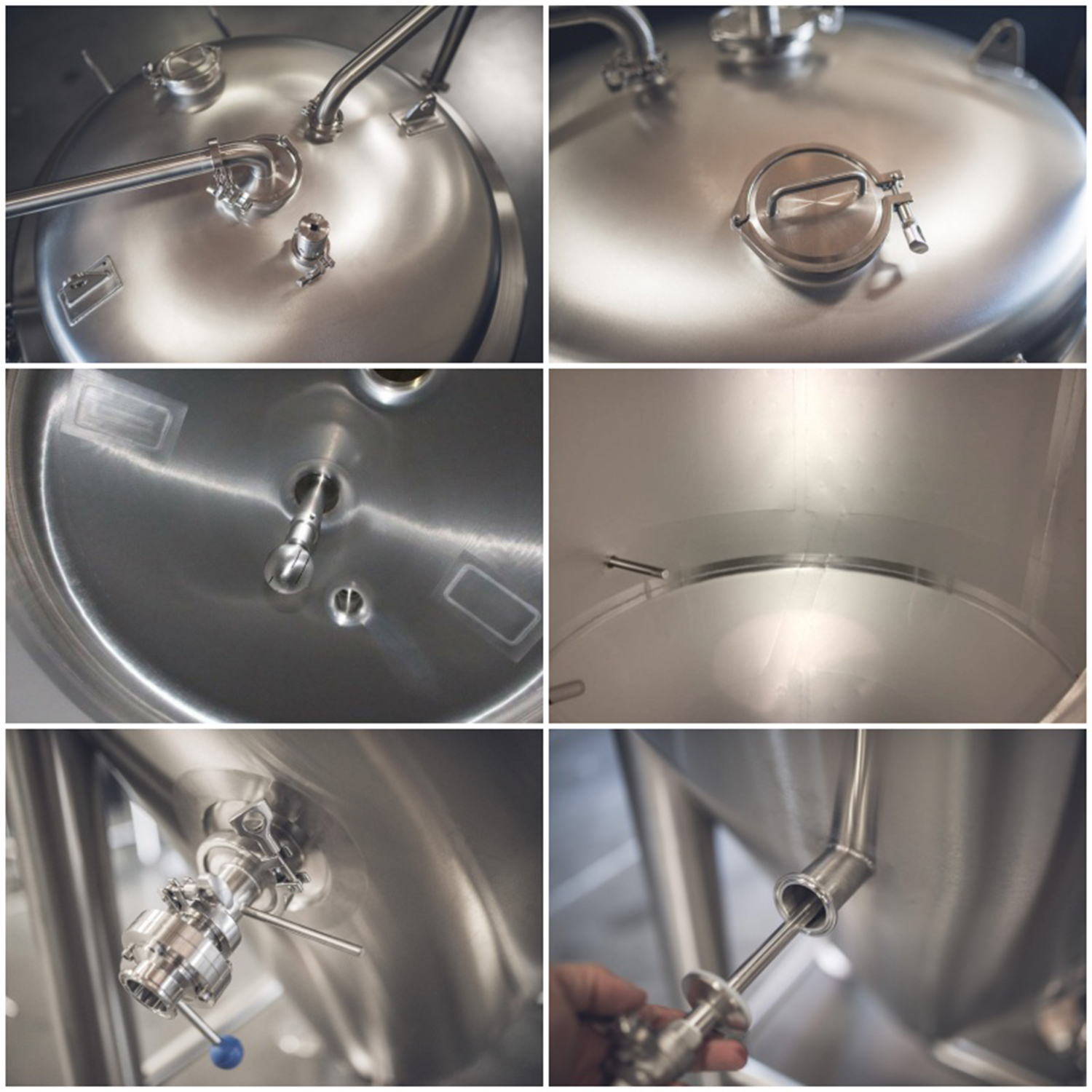
The Top Manway Fermentation Tank offers customizable specifications to align with diverse production needs, with key parameters outlined in the table below:
| Feature | Specification |
|---|---|
| Material | Food-grade SUS304 / SUS316L stainless steel |
| Interior Finish | Mirror polished, Ra ≤ 0.6 μm |
| Exterior Finish | Satin brushed / No. 4 finish |
| Design Pressure | 0.3 MPa (tested to 0.35 MPa) |
| Working Pressure | 0.15 – 0.2 MPa |
| Cooling Jacket | Dimple jacket (glycol/water) |
| Manway | Top-mounted oval manway with food-grade silicone gasket |
| Insulation | 80–100 mm Polyurethane (PU) foam |
| Standard Inclusions | Pressure relief valve, pressure gauge, CIP spray ball, sampling valve, rotary arm spray ball, butterfly valves |

Top Manway for Enhanced Access & Safety
The tank’s defining top-mounted pressure manway eliminates the need for side access ports, which are common sources of leaks in traditional tanks.
Durable & Hygienic Stainless Steel Construction
Constructed from food-grade stainless steel, the tank resists rust, chemical corrosion, and microbial growth—essential for complying with FDA and EU food safety regulations.
Flexible Temperature Control Systems
To maintain the stable temperatures required for consistent fermentation, the tank offers two temperature control options:
• Cooling Jacket: Wraps around the tank’s exterior to distribute cooling evenly, ideal for large-volume batches where uniform temperature is critical (e.g., lager beer fermentation, which requires 4–10°C).
• Cooling Tube: Inserted directly into the fermentation mixture, this option provides precise temperature adjustments for small batches or high-viscosity products (e.g., thick kombucha cultures), preventing hotspots that can disrupt microbial activity.
Shape Options for Process Optimization
• Cylindrical Shape: Suits general fermentation needs, such as ale brewing or wine primary fermentation, where maximizing volume efficiency is a priority.
• Conical Shape: Features a tapered bottom that facilitates sediment (e.g., yeast, fruit pulp) collection and removal.
Our fermentation tanks are widely used across:
Craft & Microbreweries — ales, lagers, IPAs, stouts, wheat beers
Brewpubs & Taprooms — small-batch, fresh-beer-on-site production
Nano Breweries & Pilot Systems — recipe testing and R&D
Commercial & Industrial Breweries — high-volume consistent production
Cider, Kombucha & Kefir Producers — adaptable for non-beer fermentation
Laboratory & Educational Brewing Programs — precise temperature-controlled research
| Model | Working Volume | Total Volume | Diameter (mm) | Overall Height (mm) | Recommended Use |
|---|---|---|---|---|---|
| ZPET-50 | 50 L | 70 L | Ø400 | ~1,100 | Pilot / test brewing |
| ZPET-100 | 100 L | 140 L | Ø500 | ~1,350 | Nano brewery |
| ZPET-200 | 200 L | 280 L | Ø600 | ~1,600 | Nano / small brewpub |
| ZPET-300 | 300 L | 420 L | Ø700 | ~1,800 | Small brewpub |
| ZPET-500 | 500 L | 700 L | Ø900 | ~2,100 | Brewpub / microbrewery |
| ZPET-1000 | 1,000 L | 1,400 L | Ø1,200 | ~2,600 | Microbrewery |
| ZPET-2000 | 2,000 L | 2,800 L | Ø1,500 | ~3,200 | Craft brewery |
| ZPET-3000 | 3,000 L | 4,200 L | Ø1,800 | ~3,600 | Regional brewery |
| ZPET-5000 | 5,000 L | 7,000 L | Ø2,200 | ~4,200 | Commercial brewery |
| ZPET-10000 | 10,000 L | 14,000 L | Ø2,800 | ~5,200 | Industrial brewery |
Note: Working volume = 70% of total volume to accommodate krausen during active fermentation. Custom dimensions and volumes are available on request.
Estimate your weekly production target — multiply by your fermentation duration (typically 1–4 weeks for ale, 4–12 weeks for lager).
Account for headspace — always size the total volume 30–40% above your batch volume.
Plan for growth — many brewers start with a 2–3 tank batch set and add units as demand grows.
Match your brewhouse — a common ratio is 3:1 to 5:1 (fermentation volume : brewhouse volume) for ale-only systems, and up to 6:1–8:1 for lager-heavy operations due to longer conditioning cycles.

Easy interior access — clean, inspect, and harvest yeast without awkward side-door angles
Fully sealed pressure integrity — no side-wall penetration points that could weaken the jacket
Flexible layout — side piping and jacket connections remain unobstructed for tight brewery layouts
Food-grade silicone seal — CIP-compatible, long-lasting, and easy to replace
A top manway eliminates the structural weakness of side ports, which are prone to leaks when exposed to fermentation pressure.
Yes—models with a high-pressure rating (15–30 PSI) are designed to withstand the pressure required for in-tank carbonation.
The standard material is food-grade stainless steel, with options for 304 or 316 stainless steel
Choose a cooling jacket for large-volume batches (500+ liters) or processes where uniform temperature is critical (e.g., lager fermentation). A cooling tube is better for small batches (under 500 liters) or high-viscosity mixtures (e.g., thick kombucha), as it delivers more precise, localized cooling without disrupting the fermenting liquid.
Most models offer optional CIP (Clean-in-Place) compatibility, which allows integration with automated cleaning systems. This is ideal for large-scale facilities that need to clean tanks quickly and consistently between batches. Even without CIP, the tank’s smooth internal surface and wide top manway make manual cleaning straightforward.


