
Views: 0 Author: Site Editor Publish Time: 2025-11-10 Origin: Site
A distillery is a facility where fermented liquids are transformed into higher‑strength, refined spirits through distillation. Inside a working distillery, raw ingredients such as grains, fruits, or sugarcane are mashed, fermented, distilled, sometimes aged, and finally bottled as whiskey, gin, vodka, rum, brandy, and many other spirits. Understanding how a distillery works — and how distillery equipment is used at each stage — helps drinkers, bar owners, and aspiring producers evaluate quality and make better purchasing and investment decisions.
Although every distillery has its own style and traditions, most follow a similar step‑by‑step process:
Select and prepare raw materials (grain, fruit, molasses, agave, etc.).
Mash or crush them to create a sugary liquid.
Ferment that liquid with yeast to produce a low‑strength alcoholic wash.
Distill the wash to concentrate alcohol and desirable flavor compounds.
Optionally age the spirit in barrels or tanks.
Dilute, filter, and bottle the finished product.
This framework applies whether a distillery is producing a rich single malt whisky, a neutral vodka, a botanical gin, a molasses‑based rum, or a fruit brandy. The differences lie in the exact raw materials, fermentation conditions, distillation methods, and aging regimes — all of which are tightly linked to the choice of distillery equipment.
Every distillery begins with an agricultural raw material rich in starch or sugar. Common choices include:
Grains such as barley, corn, rye, and wheat
Fruits like apples, grapes, pears, plums, and berries
Sugarcane products such as molasses or fresh cane juice
Other plant sources like potatoes or agave hearts
The goal of mashing is to turn these raw materials into a sugary liquid that yeast can ferment.
For grain‑based spirits, the process typically involves:
Milling: Crushing malted or unmalted grains in a mill to expose starch.
Mixing: Combining the grist with hot water in a mash tun or cooker.
Conversion: Allowing natural or added enzymes to convert starches into fermentable sugars.
Fruit‑based spirits often skip heavy mashing and instead focus on crushing and pressing fruit to obtain juice or a fermentable pulp.
Key distillery equipment in this stage includes:
Grain mill or crusher
Mash tun or cook kettle with agitation and heating
Transfer pumps and piping for moving mash or juice
Basic control systems to manage temperature and time
The quality of mashing has a direct impact on later stages. Efficient conversion of starch to sugar means better fermentation, higher yields, and a more consistent spirit profile.
Fermentation is the biochemical heart of any distillery. In this step, yeast consumes the sugars in the mash or juice and produces ethanol and carbon dioxide.
Typical characteristics of the fermented liquid (wash or mash) are:
Alcohol by volume (ABV) generally between 5% and 15%
Retained flavors and aromas from the raw material
A mixture of ethanol, water, and hundreds of minor compounds known as congeners
Because yeast dies once alcohol levels become too high, fermentation alone can’t create strong spirits. That’s why a distillery must rely on distillation to raise the alcohol content beyond what yeast can tolerate.
Fermentation takes place in specialized tanks that are part of the distillery equipment set:
Stainless steel fermentation tanks for hygiene and durability
Optional open fermenters for certain traditional styles
Temperature‑controlled jackets or coils to keep yeast in its optimal range
Valves, vents, and CIP (clean‑in‑place) systems to manage gases and cleaning
Controlling fermentation temperature, yeast strain, and duration allows a distillery to shape both the strength and the flavor complexity of the eventual spirit.
Distillation is the process that makes a distillery different from a brewery or winery. Instead of simply fermenting and packaging, a distillery heats the fermented liquid to separate and concentrate ethanol and selected flavor components.
The principle behind distillation is straightforward:
Pure water boils at 100°C (212°F).
Pure ethanol boils at about 78°C (173°F).
In a fermented mixture of water, ethanol, and many other compounds, the fraction with the lower boiling point tends to vaporize more readily. When the wash is heated in a still, alcohol‑rich vapors rise away from the liquid. These vapors are then condensed back into liquid form, resulting in a distillate with a higher concentration of alcohol than the original wash.
Key concepts in distillation include:
Volatility: How easily a substance vaporizes at a given temperature.
Fractions: Different groups of compounds that vaporize at different points in the run.
Condensation: The cooling process that converts alcohol vapors back into liquid.
Even though ethanol is the primary target, a distillery must also manage other volatile compounds. Some contribute pleasant flavors, while others are harsh or even toxic. Distillation allows the distiller to select which fractions to keep and which to discard or recycle.
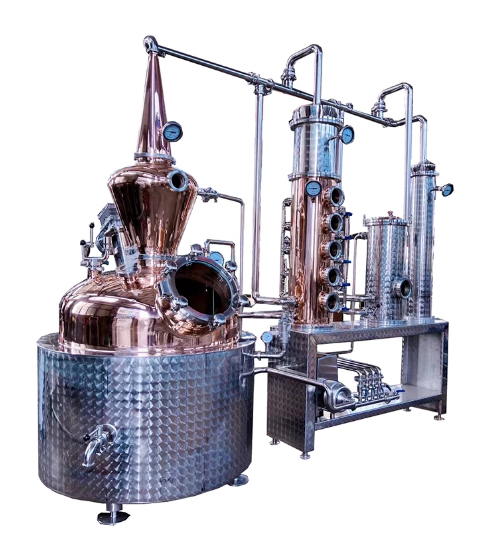
The still is the central piece of distillery equipment. While designs vary widely, most fall into three main categories: pot stills, column stills, and hybrid stills.
A pot still is one of the oldest and most recognizable distillation devices. It usually consists of:
A boiler or pot where the wash is heated
A head and neck that allow vapors to rise
A lyne arm that carries vapor to the condenser
A condenser where vapor is cooled into liquid
Pot stills operate in batches. A distillery fills the pot with fermented wash, heats it, collects the vapor as it condenses, and then empties the pot before starting again.
Typical attributes of pot still distillation:
Produces spirits with pronounced character and heavier congeners
Common for single malt whisky, many rums, brandies, and some gins
Requires careful management of each batch and cleaning between runs
Pot stills are often crafted from copper, which helps bind sulfur compounds and improve flavor. Many small and craft distilleries favor pot stills for their ability to create distinctive, regionally expressive spirits.
Column stills, sometimes called continuous stills, are tall vertical structures divided into multiple plates or trays. Instead of working batch by batch, they can operate continuously:
Fermented wash is fed into the column at one or more points.
Steam rises from the bottom, meeting descending liquid on each plate.
On each plate, some vapor condenses and some liquid vaporizes, gradually enriching the rising vapor in ethanol.
By the time the vapor reaches the top, it can be extremely high in alcohol content. This design allows a distillery to generate large volumes of spirit at consistent strength and purity.
Key advantages of column stills:
Greater efficiency and throughput than batch pot stills
Ability to produce very high ABV neutral spirits, ideal for vodka and neutral grain spirits
Reduced downtime because the system can run continuously
Because they strip out more congeners, column stills are associated with cleaner, lighter spirits. However, by adjusting reflux and plate design, they can also produce flavorful whiskeys and rums.
Hybrid stills combine elements of both pot and column design. A typical configuration might be:
A pot base for initial boiling and flavor development
One or more column sections mounted above or alongside the pot
Valves that allow the distillery to use only the pot, only the column, or both
Hybrid distillery equipmentoffers flexibility to produce a range of spirits in a single system — making it popular among smaller operations that need versatility and efficient use of space.
As the wash is distilled, the composition of the vapor — and the resulting liquid distillate — changes over time. Distillers generally divide the run into several fractions:
Heads (or foreshots): The first portion to come off the still, rich in highly volatile compounds including some that are undesirable or unsafe in high concentration.
Hearts: The central fraction, containing the bulk of the ethanol and a controlled amount of congeners that contribute positive aroma and flavor.
Tails: The final part of the run, heavier in higher‑boiling compounds and fusel oils that can lend off‑notes if not handled carefully.
Congeners are the additional flavor and aroma compounds created during fermentation and released during distillation. They include esters, aldehydes, and various higher alcohols. Some congeners are responsible for the fruity or spicy notes that define many spirits; others can be rough or solvent‑like.
Making “cuts” — deciding where the heads end and the hearts begin, and where to switch from hearts to tails — is one of the most critical skills in a distillery. It determines:
The spirit’s cleanliness or richness
How well it will age in barrel
The final aroma, flavor, and mouthfeel
Accurate thermometers, sight glasses, and collection vessels are important pieces of distillery equipment in this stage, but experience and sensory evaluation remain irreplaceable.
Once a distillery has produced a clean, usable spirit, it must decide what happens next. Some products are bottled almost immediately, while others spend years in wood.
Many spirits — such as bourbon, rye, Scotch whisky, and aged rum — are matured in wooden barrels. During aging, several processes occur:
Extraction: Compounds from the wood, including vanillin, lignin, tannins, and caramelized sugars, dissolve into the spirit.
Oxidation: Slow exposure to oxygen mellows harsh notes and helps integrate flavors.
Concentration: Some evaporation occurs (“the angel’s share”), which can intensify flavors.
The type of wood, level of toasting or charring, previous barrel contents, and length of aging all influence the flavor profile. Barrel warehouses, racks, and monitoring tools are therefore critical parts of distillery equipment for producers who age their spirits.
Before bottling, most spirits are adjusted and clarified:
Proofing: Adding clean water to bring the spirit down from cask or still strength to the desired bottling strength (for example, 40% ABV).
Filtration: Passing the spirit through filter pads, charcoal, or other media to remove particles and, in some cases, certain flavor compounds or haze‑forming elements.
This stage allows the distillery to fine‑tune clarity, mouthfeel, and consistency across batches.
The final step in a distillery is getting the finished spirit into bottles:
Storage in bright tanks or holding tanks
Automatic or semi‑automatic filling machines
Capping or corking equipment
Labeling systems and packing lines
Even small distilleries increasingly rely on efficient bottling equipment to maintain product quality and meet demand.
A functioning distillery relies on a coordinated set of machines and vessels. Core categories of distillery equipment include:
Milling equipment: Grain mills or crushers.
Mashing equipment: Mash tuns and cookers with heating, stirring, and temperature control.
Fermentation tanks: Stainless or other food‑grade vessels with jackets, valves, and CIP.
Stills: Pot stills, column stills, or hybrid stills, often made of copper or stainless steel.
Condensers and heat exchangers: Shell‑and‑tube or other designs to cool vapor efficiently.
Pumps and piping: For moving liquids between stages safely and hygienically.
Utilities support: Steam boilers, glycol chillers, air compressors.
CIP systems: For automated cleaning of tanks, lines, and stills.
Aging infrastructure: Barrels, racks, warehouse environmental controls.
Bottling and packaging: Filling, closing, labeling, and packing equipment.
Choosing and sizing this equipment correctly is essential for operational efficiency, regulatory compliance, and product quality.
Different distilleries specialize in different spirit categories, and their processes are tailored accordingly.
Use grain mashes (often barley, corn, rye, or blends).
Typically employ both pot and column stills, depending on style and tradition.
Age the new‑make spirit in oak barrels for years to develop flavor, color, and smoothness.
Can start from grains, potatoes, or other fermentable bases.
Often rely on column stills and multiple distillations to achieve high purity.
Focus on filtration to produce a neutral, clean spirit with minimal flavor.
Use sugarcane derivatives such as molasses or fresh juice.
May use pot stills for heavier styles or column stills for lighter styles.
Some rums are bottled unaged; others spend significant time in oak.
Start with neutral spirit (often column‑distilled) as a base.
Redistill with juniper and other botanicals or use vapor infusion techniques.
Focus distillery equipment around botanical baskets, flavor control, and blending.
Work with apples, grapes, stone fruits, berries, or other botanicals.
Often use pot stills to capture delicate aromatics.
May apply unique aging or finishing methods to highlight regional character.
A typical day in a distillery involves coordinated activity across multiple stages:
Receiving and inspecting raw materials
Milling and mashing grains or preparing fruit
Managing active fermentations and monitoring temperature and gravity
Operating stills and making cuts for new‑make spirits
Filling and monitoring barrels in the warehouse, where applicable
Running laboratory checks for ABV, flavor, and quality control
Bottling, labeling, and preparing finished goods for shipment
In many cases, hosting tours and tastings for visitors
Effective scheduling and process control ensure that each part of the distillery runs efficiently without bottlenecks.
Distilleries occupy a unique place at the intersection of industry, culture, and gastronomy:
Economic impact: They create direct jobs, support farmers, generate tax revenue, and often anchor tourism in their region.
Cultural legacy: Historic distilleries preserve traditional techniques and contribute to local identity through region‑specific spirits.
Craft and innovation: Modern craft distilleries experiment with local grains, unusual botanicals, and novel barrel finishes, expanding what spirits can be.
Whether large‑scale industrial plants or small, family‑run operations, distilleries continue to shape how communities grow, celebrate, and express their heritage.
Different organizations emphasize different aspects when they explain how distilleries operate. Their viewpoints collectively build a fuller picture of the process.
Stresses that distilling is necessary because yeast cannot ferment beyond moderate alcohol levels.
Describes pot distillation as a batch method where congeners and flavor compounds are carefully managed.
Highlights column distillation as a continuous, highly efficient approach capable of producing very high‑ABV spirits.
Breaks the distillation run into fractions — fores, head, heart, and tail — to show how cuts shape the final spirit.
Defines a distillery as any facility that transforms a low‑alcohol wash into a stronger, more purified spirit through controlled heating, cooling, and collection.
Outlines a common process for most spirits: fermentation, distillation, optional aging, and bottling.
Describes categories of distilleries by spirit type — whiskey, vodka, rum, gin — and how each adapts equipment and techniques.
Emphasizes that distilleries are important both economically and culturally, and that modern craftsmanship builds on centuries of tradition.
Provides detailed descriptions of core distillery equipment such as pot stills, column stills, hybrid stills, fermentation tanks, and mixing tanks.
Uses malt‑based whisky production as an accessible example of how a distillery works.
Explains how a wash made from malted barley, yeast, and water is fermented to beer‑like strength, then distilled in pot stills.
Describes how heads, hearts, and tails are separated, with only the hearts going into barrels for aging.
Notes that many American whiskeys are distilled on column stills while some rums and other spirits rely on pot stills.
Shows that blending spirits from different distillation methods can create complex, layered products.
Frames distillation as a technique to select and concentrate fractions from a fermented liquid, especially ethanol and flavorful components.
Focuses on boiling points and how the fraction with the lower boiling point becomes more concentrated in the vapor phase.
Emphasizes that, despite their alcoholic strength, spirits are ultimately about flavor, not just ethanol content.
Points out that all stills, no matter how sophisticated, rely on the same basic principles of selection and concentration.
Presents distillation as a core concept in structured spirits education.
Treats alcohol distillation as an intersection of chemistry, physics, and craftsmanship.
Begins with fermentation, noting that wash typically sits at 5–15% ABV before being distilled.
Explains how heating the wash, vaporizing ethanol, condensing the vapor, and collecting distillate all contribute to higher strength and controlled flavor.
Defines hearts, head, and tail fractions and how adjusting temperature and timing influences quality and character.
Compares pot still and column still methods in terms of batch vs. continuous operation and flavor richness vs. purity.
Introduces scientific concepts such as volatility and azeotropes to clarify why there are limits to how pure ethanol can become via simple distillation.
Uses apple‑based spirits as a case study to illustrate how a distillery can be integrated into a working farm.
Describes how apples are washed, crushed, and pressed to produce sweet cider, which then undergoes controlled fermentation.
Details a two‑stage pot distillation process in which hard cider is first concentrated and then redistilled to isolate a high‑strength heart cut.
Shows how aging in used bourbon barrels over several years transforms fresh apple character into deeper notes of caramel, vanilla, and toasted coconut.
Emphasizes the value‑adding role of a distillery in turning surplus or imperfect fruit into long‑lasting, premium spirits.
Anyone planning to build or expand a distillery must align equipment choices with business goals. Key considerations include:
Target spirits: Whiskey, gin, vodka, rum, brandy, or a portfolio of several categories.
Production volume: Small‑batch craft output vs. large‑scale continuous production.
Space and utilities: Available floor area, ceiling height, water, power, and steam.
Budget and scalability: Ability to grow capacity over time without major redesign.
Automation level: Manual operations vs. semi‑automated or fully automated control.
For example:
A small craft whiskey distillery might choose copper pot stills and a modest number of fermentation tanks, focusing on characterful batches and extended aging.
A vodka distillery might invest in tall column stills with many plates, allowing efficient production of neutral spirit at high ABV.
A flexible, mixed‑category distillery might opt for a hybrid still that can operate in both pot and column modes.
Working with experienced distillery equipment suppliers and engineers helps ensure that the chosen setup meets technical, safety, and regulatory requirements while supporting the desired spirit styles.
Is all alcohol produced in a distillery?
No. Beverages like beer, wine, and cider are produced only by fermentation and are not distilled. A distillery is required when a producer wants to create higher‑strength spirits such as whiskey, vodka, gin, rum, and brandy.
What is the difference between a distillery and a brewery?
A brewery ferments a sugary liquid into beer and then typically filters, carbonates, and packages it without distilling. A distillery ferments a similar liquid but then uses distillation to separate and concentrate alcohol, producing stronger spirits that may be aged and then bottled.
Why are some spirits aged and others not?
Aging in wood barrels can add flavor complexity, soften rough edges, and contribute color. Whiskey, rum, and many brandies rely heavily on aging for their character. Vodka and some gins, by contrast, are usually valued for their purity and freshness, so they may be bottled without aging.
Can individuals legally distill spirits at home?
In many countries and regions, distilling alcohol at home without proper licensing is illegal, even for personal consumption. It can also be dangerous if done without the correct equipment and safety knowledge. Regulations vary, so it is essential to check local laws before attempting any kind of distillation.
What is the most important piece of distillery equipment?
All components are important, but the still is the core of any distillery because it performs the actual distillation. However, without proper mashing, fermentation, condensation, utilities, and bottling equipment, a still alone cannot produce consistent, high‑quality spirits.
A distillery is far more than a single still; it is a coordinated system that takes agricultural raw materials through mashing, fermentation, distillation, optional aging, and final packaging. Distillation, guided by the principles of boiling points and volatility, allows a distillery to select and concentrate both ethanol and desirable flavor compounds. The choice and configuration of distillery equipment — from mash tuns and fermentation tanks to pot or column stills, condensers, and bottling lines — determine not only production efficiency but also the character and quality of the final spirits.
For enthusiasts, professionals, and aspiring producers alike, understanding how a distillery works transforms a simple bottle into the result of thoughtful design, scientific precision, and centuries of evolving craft.


